There is a specific and haunting phenomenon in the software world: the company that reaches two million dollars in annual recurring revenue with ease only to find that reaching ten million feels like pushing a boulder up a mountain of sand. Investors call this the Series B Gap. On paper, the company is growing, but underneath the surface, the founder magic that powered the early days has become the very thing holding the company back. It is a hard truth to hear, but the founder is often the primary source of friction. They are the engine that started the car, but now they are the brake.
The Statistical Reality of the Scaling Gap
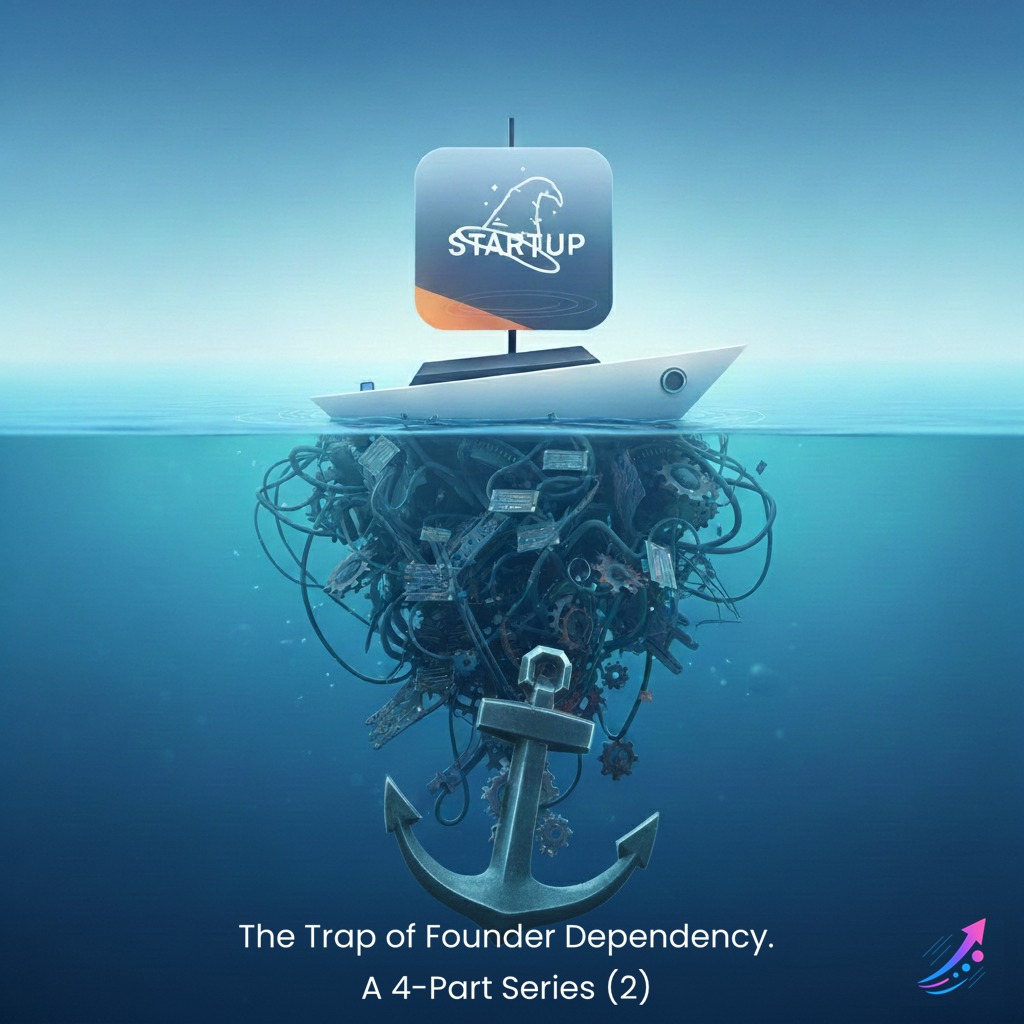
The statistical reality of this transition is stark. Data from Crunchbase and Correlation Ventures shows that from Seed to Series A: only 1 in 3 startups that raise seed funding successfully raise a Series A round. Further, from Series A to B: approximately 35% of Series A companies fail before raising Series B funding. The drop is not always due to a lack of revenue but a lack of scalable systems. The label on the jar for these companies often reads: high founder dependency. When every significant decision must pass through one or two people, the organization loses its ability to react to the market. The buoyancy fails because the structure of the team was not built for autonomy. it was built for execution of a single person’s vision.
The Human Cost of Centralized Control
In the early stages, the founder is the glue. They are in every meeting, they interview every hire, and they fix every bug. This is necessary at first, but it creates a culture where no one else feels empowered to lead. As the company grows, the founder becomes a human bottleneck. I have seen founders work 80 hour weeks just to keep the status quo, while their talented directors sit around waiting for an email reply. The team stops thinking for themselves and begins waiting for permission. This creates a massive amount of invisible friction. Every department has to wait for the founder to find a spare hour to review a document or approve a strategy.
Shifting from Hands On Doing to Architectural Thinking
Overcoming this ceiling requires a radical shift from doing to architecting. It requires a structured assessment of the leadership layer to identify where the founder bottleneck is strangling growth. This involves moving away from heroic individual efforts and toward repeatable systems. If the founder is still the only person who can close a major deal, the company is not a scalable business. it is a high performing consultancy. True scaling requires a business that can grow while the founder is on vacation. If you cannot step away for a month without the revenue dropping, you do not have a company. you have a job with a lot of employees and a very high stress level.
Building the Trust Infrastructure for Autonomy
To break through to Series B, the leadership must build a trust infrastructure that allows the team to move fast without the founder in the room. This means defining clear roles, establishing measurable outcomes, and giving people the authority to make mistakes. This transition is often painful because it requires letting go of the control that created the initial success. However, it is the only way to stop the slow sink into irrelevance. Scaling is not about doing more of the same. it is about changing the fundamental physics of how the organization moves. A structured assessment helps the founder see their own company through the eyes of their employees, revealing exactly where their involvement is helping and where it is hurting.
What’s one decision that still has to go through you every single time?
Bal Mattu. Ktaria. Diagnostic assessments for Pre-Seed to Series B startups.